
Soil is one of the most important natural resources. It provides anchorage to the plants and supplies water and nutrients. So, we have learnt about the soil.
Soil is composed of distinct layers. Perform the following activity to find out how these layers are arranged.
The rotting dead matter in the soil is called humus.
The soil is formed by the breaking down of rocks by the action of wind, water and climate and the process is known as weathering. The nature of any soil depends upon the rocks from which it has been formed and the type of vegetation that grows in it.
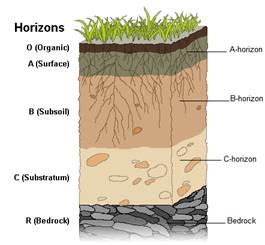
A vertical section through different layers of the soil is called the soil profile.
Each layer differs in feel (texture), colour, depth and chemical composition. These layers are referred to as horizons.
The humus makes the soil fertile and provides nutrients to growing plants. This layer is generally soft, porous and can retain more water. It is called the topsoil or the A-horizon.
The mixture of rock particles and humus is called the soil. Living organisms, such as bacteria, plant roots and earthworm are also important parts of any soil.
The soil is classified on the basis of the proportion of particles of various sizes. If soil contains greater proportion of big particles it is called sandy soil.
If the proportion of fine particles is relatively higher, then it is called clayey soil. If the amount of large and fine particles is about the same, then the soil is called loamy.
The best topsoil for growing plants is loam. Loamy soil is a mixture of sand, clay and another type of soil particle known as silt. Silt occurs as a deposit in riverbeds.
It has the right water holding capacity for the growth of plants.
The soils contain various mineral particles, organic matter, water and air. So based on the different containing of various substances Soils have different-different properties.
We learnt that the is the mixture of various substances. When we heating the soil, the water in the soil evaporate, moves up and condenses on the cooler inner walls of the upper part of the boiling tube.
It means that there is the moisture in the soil.
The soils absorb the water. We can check it by the Pour water all over the little amount of soil. Keep pouring water till it starts dripping out of the soil.
It means the soil absorb the water. The different type of soil has the different capacity of pouring the water.
Different types of soils are found in the world. In some parts there is clayey soil, in some parts there is loamy soil while in some other parts there is sandy soil.
Soil is affected by wind, rainfall, temperature, light and humidity.
Clayey and loamy soils are both suitable for growing cereals like wheat, and gram. Such soils are good at retaining water. For paddy, soils rich in clay and organic matter and having a good capacity to retain water are ideal.